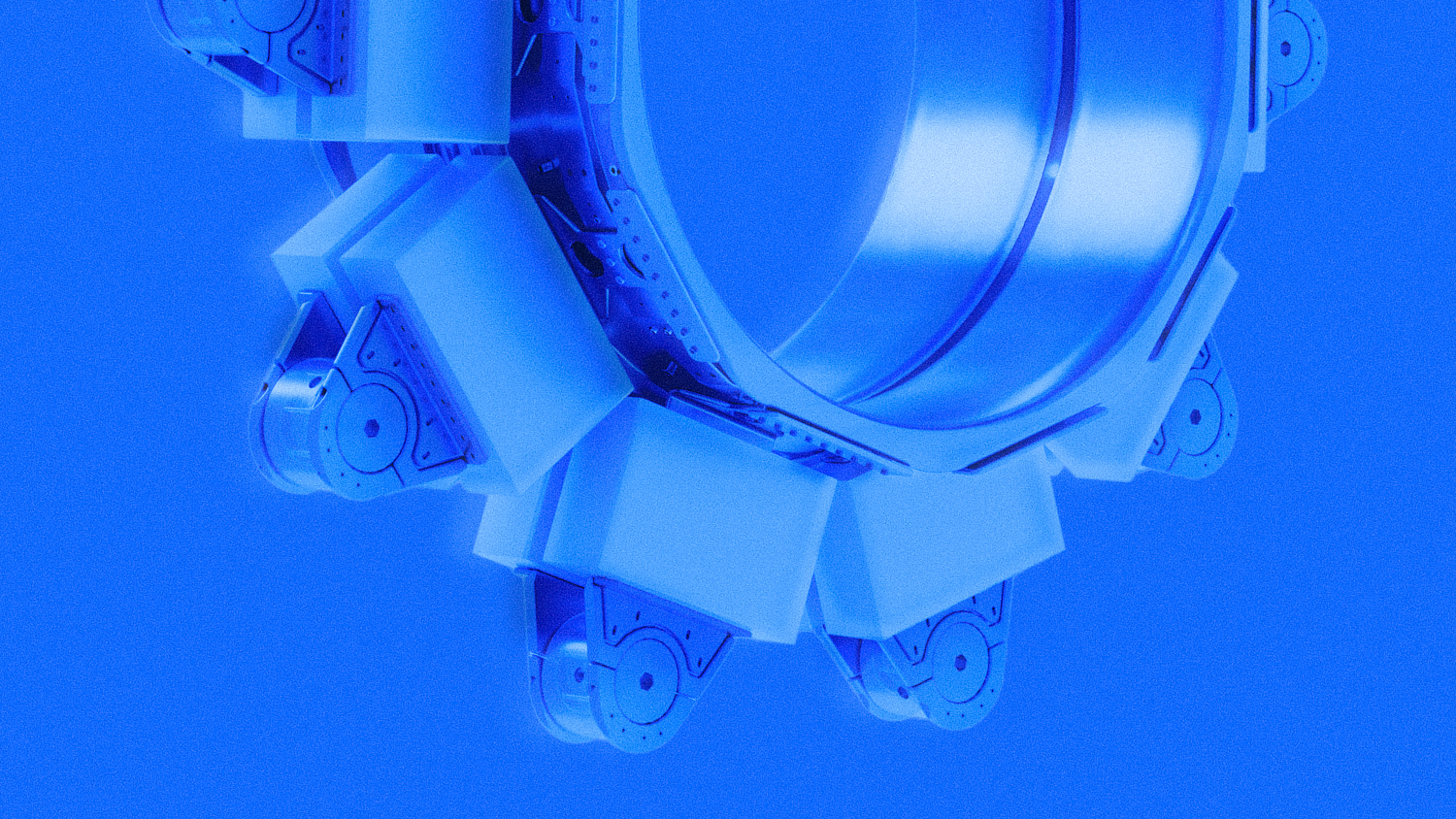
Simulations are helping us design and predict how Pacific Fusion’s Demonstration System will perform. This week, at the American Physical Society’s Division of Plasma Physics (APS DPP) annual meeting, co-founder and VP of Technology Leland Ellison presented new research showing that our latest simulations project fusion energy output well above the level needed to make fusion power practical.
In Pacific Fusion's first invited APS DPP talk, Ellison shared full multidimensional simulations of fusion targets designed to achieve net facility gain, a critical milestone on the path to fusion power. He detailed our methodology and validation work, in addition to addressing our next key challenges and milestones.
The presentation also featured new 3D visualizations (example shown below) developed in collaboration with NVIDIA, which included a simulation projecting 500 megajoules of fusion energy from our Demonstration System, five times the net facility gain threshold. NVIDIA's cuPhoton group developed software to transform FLASH simulation data into detailed visualizations using the NVIDIA Omniverse platform, giving us a new way to show pulser fusion physics that has historically been hard to illustrate.
Ellison’s talk was one of 18 Pacific Fusion presentations at this year’s conference, which spanned topics from target design to experimental validation. Sharing this work reflects our commitment to open science, and shows how fundamental physics is informing our engineering decisions as we move from R&D into execution.

Here are a few of the other challenges that our presented research is helping solve.
Designing fusion targets for high yields
As we plan our first experimental campaigns, we’re working to get more out of our targets. We presented quantitative thresholds for ignition and self-heating plasmas and showed that our target simulations agree closely with them. We also shared a new fundamental theory for key hydrodynamic instabilities, which will help us design targets that hold up better under extreme conditions. And we built an end-to-end pipeline that uses AI-assisted simulations of quantum interactions and molecular dynamics to help us explore new target materials with greater accuracy.
Advancing simulation capabilities
In the past year, our simulation tools have gone from single-calculation proofs of concept to supporting the planning and fielding of our first experimental campaign. This year, we presented both large ensembles involving thousands of 1D calculations and new capabilities for fully 3D simulations. We also shared a new model for how fusion-generated particles deposit energy back into the fuel, giving more accurate results for high-gain fusion targets.
Challenging our codes against nature
Simulations are only useful if they match reality, and as our work has advanced, we’ve started testing our codes against data from the world’s leading pulsed-power facilities. We used our new 3D capabilities to model experiments on Imperial College London’s MAGPIE driver, exploring how to reduce the material consumed in each shot. And under a Cooperative Research and Development Agreement with Sandia, we completed a series of shots on the Z Machine to support improved target design. The results helped validate a far simpler target that eliminates costly hardware traditionally replaced after every shot. We also fielded experiments on Z via the Z Fundamental Science campaign, collaborating with universities to better model dynamics relevant to astrophysical jets and challenge our modeling capabilities in new ways.
We’re building the hardware to make fusion power real. At APS DPP 2026, we showed we’re developing, validating, and sharing the science behind it just as quickly, translating decades of lab progress into practical, affordable and scalable fusion power systems.

